


Spotify (SPOT) is done chasing users, and its next growth phase may be about monetization. Spotify is already the global leader in streaming audio, but the next leg of the story may come less from simply adding users and more from earning more from its most engaged fans. The stock is down nearly 30% over the past 12 months, while the S&P 500 (SPX) is up more than 23% over the same period. I see that underperformance as an opportunity, and I am bullish on SPOT because the company’s monetization playbook is becoming more credible.
Spotify has roughly 761 million monthly active users, including about 293 million paid subscribers. That scale is hard to replicate. What matters now is whether Spotify can turn that audience into higher average revenue per user (ARPU), stronger margins, and more durable free cash flow. After its 2026 Investor Day, I think the answer is increasingly yes.

Monetization Is Becoming the Main Story
Monetization is becoming the main story because Spotify is no longer just trying to prove that streaming audio can scale. It has already done that. The more interesting question is how much more value it can extract from its best users.
Management’s Investor Day made this shift clear. Instead of focusing only on a broad “Super Premium” tier, Spotify is moving toward multiple add-ons across music, podcasts, audiobooks, artificial intelligence (AI) tools, fitness, and live access. I like this approach because it is more flexible. Not every user needs every feature, but highly engaged users may pay meaningfully more for the features they actually care about.
Premium Platinum is an early proof point. The tier is priced at more than twice the standard Premium offering, yet more than 7% of subscribers are already using it just a few months after launch, despite limited marketing. That tells me Spotify may have more pricing power than investors appreciate.
AI Could Strengthen Spotify’s Moat
AI could strengthen Spotify’s moat rather than weaken it. The company’s new AI licensing agreement with Universal Music Group (UMGNF) is important because it gives Spotify a framework to participate in AI-driven music creation without stepping outside the rights ecosystem.
The deal will allow Spotify to launch paid tools that let users create covers and remixes of songs by participating artists. Management expects the feature to be margin-neutral or margin-accretive, which is exactly what I want to see. AI products that drive engagement but destroy margins are not attractive. AI products that improve monetization and deepen the user relationship are different.
Spotify’s “Large Taste Model” is also worth watching. While many companies are chasing large language models, Spotify is leaning into its own strength: decades of listening data, taste signals, playlist behavior, and engagement history. That data can improve personalization, conversion, pricing segmentation, and product recommendations. In my view, this is where Spotify’s moat lives.
Engagement Remains a Powerful Advantage
Engagement remains a powerful advantage for Spotify. Management said more than two-thirds of all Premium music streams occur on Spotify, and more than 100 million paid subscribers use the platform more than 28 days per month. That is not casual usage. That is habit formation.
Spotify also has growing traction beyond music. More than 500 million users have streamed video podcasts, up 50% year-over-year, and the company says it has captured roughly 20% of the U.S. audiobooks market. Audiobooks Plus already has more than 1 million paying users and is expected to reach about $100 million in annual recurring revenue in July.
This matters because the core music business historically has lower gross margins due to label payouts. Podcasts, audiobooks, marketplace tools, ticketing, artist services, and AI add-ons can gradually shift the mix toward higher-margin revenue.
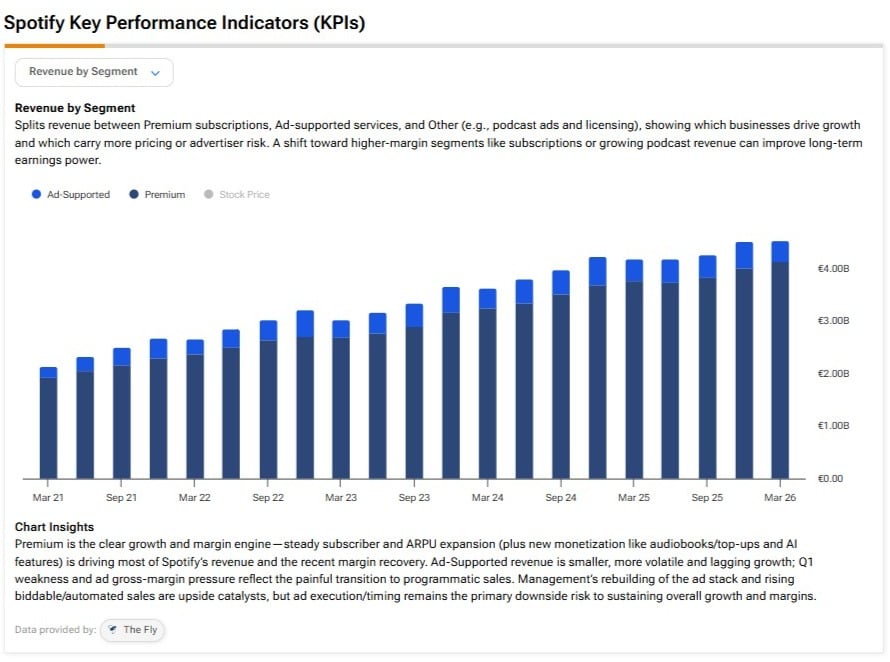
The 2030 Targets Look Ambitious but Reasonable
The 2030 targets look ambitious but reasonable because they are supported by several growth levers rather than by a single heroic assumption. Spotify is targeting more than 1 billion monthly active users (MAUs), mid-teens revenue CAGR, 35% to 40% gross margins, and operating margins around 20%.
Those are big numbers, but they are not fantasy. The company’s paid subscriber base still represents only a small portion of the global population, and management noted that Spotify’s paid subscriber count is already roughly double the size of any other music service. International growth remains meaningful, with India now generating three times as many net subscribers as it had in 2022.
Still, I do not think the stock’s upside depends only on subscriber growth. The more exciting part is ARPU expansion through pricing, add-ons, AI products, audiobooks, podcasts, ticketing, and better ad monetization. If Spotify can lift monetization while keeping churn low, earnings growth can outpace user growth.
Valuation Is Rich, but the Quality Is Improving
Valuation is rich, and I would not pretend otherwise. Spotify trades at about 33x, compared with a sector median of around 17x. It also trades at roughly 35.4x free cash flow, versus a sector median near 8x.
That is a premium valuation. However, I think traditional valuation metrics miss part of the transition happening here. Spotify is becoming a more profitable, more disciplined, and more diversified platform than it was during its subscriber-growth-at-all-costs phase.
Management is also using AI internally to improve efficiency. AI coding tools have reportedly boosted developer productivity by about 76%, and management said that even non-engineers can now test new features in days rather than quarters. That could help Spotify move faster without allowing costs to run wild. So yes, the stock is expensive. However, if Spotify can deliver mid-teens revenue growth, expanding gross margins, over 20% operating margins, and strong free cash flow, I think the premium can be justified.
Wall Street’s View
According to TipRanks, Spotify carries a Strong Buy consensus rating, with 20 Buy, five Hold, and no Sell ratings. Based on 25 Wall Street analysts offering 12-month price targets, the average target price is $604.09, implying about 21.74% upside from the recent price of $496.22.

Conclusion
Spotify’s next phase is not just about adding more subscribers. It is about better monetizing the users it already has, especially the most engaged ones. The company’s AI roadmap, UMG licensing deal, add-on strategy, audiobooks momentum, and improving margin targets all point in the same direction.
I am bullish on SPOT. The valuation is not cheap, but the business is becoming more attractive, profitable, and more strategically interesting. After a nearly 30% decline over the past year, I think the market is offering investors a chance to buy a premium audio platform before the monetization story is fully reflected in the stock price.