


Not content with being the king of data center AI chips, Nvidia (NASDAQ:NVDA) is now pushing into the personal computer realm in a bid to take share in a segment led by peers Intel, AMD, and Qualcomm.
Speaking at Computex on Monday, Nvidia CEO Jensen Huang unveiled RTX Spark, the company’s new Arm-based PC superchip developed in collaboration with MediaTek and integrated with Microsoft Windows AI capabilities. Set to launch this fall in systems from Dell, HP, ASUS, Lenovo, and MSI, RTX Spark combines a 20-core Grace CPU with a Blackwell GPU and up to 128GB of unified memory, marking Nvidia’s most significant push yet into the Windows PC market.
Investors are reacting positively to the news, with shares up by 4% in Monday’s session, the uptick also buoyed by the latest note from D.A. Davidson analyst Gil Luria.
Luria has added Nvidia to the investment firm’s Best-of-Breed Bison list, which highlights companies with strong long-term characteristics such as robust cash generation, high margins, strong leadership, and durable competitive advantages. Nvidia met 10 of the 12 criteria required for inclusion.
A key factor behind the selection is what Luria sees as Nvidia’s “outstanding business opportunity.” As the leading provider of AI infrastructure hardware and software, Nvidia is positioned at the center of a rapidly expanding market that it estimates could reach $3 trillion to $4 trillion by 2030. The company has also cited more than $1 trillion of cumulative demand for its next-generation platforms through 2027.
Luria also points to Nvidia’s “enduring moat,” built on its integrated AI platform spanning GPUs, networking, and software. The company’s CUDA ecosystem, combined with continued innovation across architectures such as Blackwell and Rubin, has helped establish Nvidia as the preferred AI infrastructure provider for hyperscalers, AI labs, and enterprises.
Nvidia’s “exceptional financials” also get a special mention. These include non-GAAP gross margins of roughly 70%–75%, operating margins around 60%, and free cash flow margins above 40%. These reflect “strong operating leverage and efficient capital allocation,” with the margin profile placing the chip giant “at the top end of the peer group.”
Interestingly, the two criteria Nvidia didn’t cut the mustard on are that it lacks a “straightforward and easy-to-understand business model,” while it does not offer a compelling risk/reward due to not trading at a “meaningful discount to its intrinsic value.”
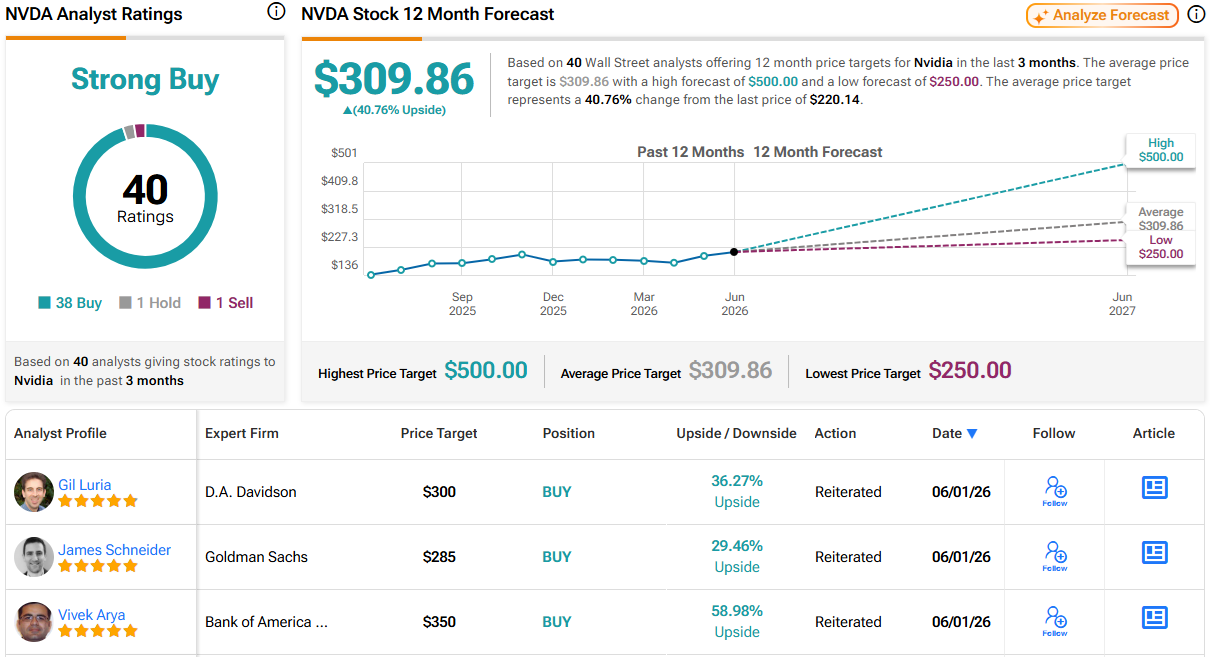
All told, Luria maintained a Buy rating on the shares, while his $300 price target points toward one-year gains of 36%. (To watch Luria’s track record, click here)
The Street wholeheartedly agrees with Luria’s thesis. The stock claims a Strong Buy consensus rating, based on a lopsided mix of 38 Buys and 1 Hold and Sell, each. Going by the $309.86 average price target, a year from now, shares will be changing hands for a 41% premium. (See Nvidia stock forecast)
Disclaimer: The opinions expressed in this article are solely those of the featured analyst. The content is intended to be used for informational purposes only. It is very important to do your own analysis before making any investment.