


Advanced Micro Devices (AMD) makes chips that power artificial intelligence (AI), and for most of its history, that was its identity. Not anymore. AMD has spent the past two years quietly expanding into software, cloud infrastructure, and strategic partnerships in ways that make it look less like a hardware supplier and more like a platform company with a real shot at a much bigger role in the AI economy.
My stance is neutral. The direction is right, and the execution has been better than most expected. However, the stock has had a remarkable run this year, and at current prices, there is not much room for disappointment.
What Is Actually Changing at AMD
What is actually changing at AMD is harder to see from the outside, but it is the most important part of the story. Most people look at AMD and see a chip company that is doing well because AI demand is strong. That is true, but it misses the bigger picture. AMD is trying to become the kind of company that large enterprises build AI systems around, which is a very different and much more valuable business.
Here is the simple version. When a company buys a chip, the sale is done. When a company builds its entire AI operation around a platform, the relationship only grows from there. AMD is chasing the second kind of relationship, and the partnerships it has signed this year are the clearest sign that it is getting somewhere. That is the same shift that turned Microsoft (MSFT) from a software seller into something most companies simply cannot function without.

The Deals Tell the Bigger Story
The deals tell the bigger story about where AMD is heading. Earlier this year, AMD invested $150 million of its own capital in the cloud computing company Nutanix (NTNX) to jointly build AI infrastructure. That is not a marketing arrangement. Companies do not write nine-figure checks for press releases. It is a signal that AMD is serious about becoming part of how large enterprises run AI, not just what powers the chips inside their servers.
AMD’s chips now power AI workloads at Meta Platforms (META), which has agreed to deploy AMD hardware at a scale that would have seemed unlikely a year ago. A year ago, many assumed Nvidia (NVDA) would win almost every contract like this. That assumption is quietly being revised, and each new win for AMD makes the next one easier to close.
The Stock Has Already Priced In a Lot
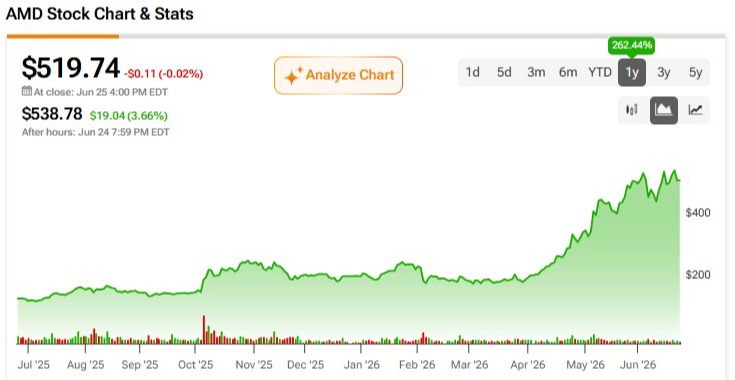
The stock has already priced in a lot of what AMD is building, and that is the part of the story worth sitting with. AMD has climbed more than 140% this year. The average analyst price target now sits below the stock’s current price, which is unusual for a company with a Strong Buy consensus. It means the market has moved faster than even the most optimistic analysts on Wall Street.
That does not make AMD a bad investment. It makes it a more demanding one. The business is growing quickly, and the strategy is sound, but at these prices, there is very little forgiveness built in. AMD currently trades at a forward P/E of roughly 70x what analysts expect it to earn in Fiscal 2026, while the average chip company trades at roughly 23x. A single soft quarter could undo months of gains, and that is a risk worth taking seriously.
What Wall Street Thinks
Wall Street’s view of AMD is largely positive, despite valuation concerns. AMD carries a Strong Buy consensus, with an average price target of $497.79. This implies a potential 4.22% downside from current prices.

Bank of America Securities analyst Vivek Arya reiterated his Buy rating and raised his target in June, calling AMD the top chip pick for what he sees as an era driven by AI processing demand. Citi analyst Atif Malik recently upgraded AMD to Buy, saying the data center business alone is worth more than the market is giving it credit for. Wolfe Research analyst Chris Caso thinks AMD could beat estimates for both this year and next.
The picture is consistent. Analysts like the business and where it is heading. The main debate is not whether AMD is well-positioned for the AI era; it is whether the stock price already reflects that.
Where AMD Stands Today
Where AMD stands today is a more interesting place than most investors expected it to be. A year ago, the company was still fighting for credibility in AI. Today, it has contracts with some of the biggest spenders in the industry, a growing software business, and a clear strategy to become more than a hardware supplier. That shift took longer than bulls hoped and happened faster than skeptics expected.
The question for investors is straightforward. Do you believe AMD can keep growing fast enough to justify what the market is already paying for it? If yes, the stock still makes sense at these levels. AMD’s data center business is gaining real momentum, its software strategy is taking shape, and the list of major companies choosing AMD over rivals keeps growing. If you think the AI spending cycle might slow or that AMD might lose ground to rivals, then the current price does not leave much cushion. That is the honest trade-off, and it is one worth thinking through carefully before deciding which side you are on.